
What does OSHA actually require for handwashing?
OSHA 1926.51(f)(1) requires washing facilities specifically where crews apply paints, coatings, herbicides or insecticides, or handle other contaminants. It is not a blanket handwashing rule for every job site. If your crew is just framing or pouring concrete, that clause does not apply. Where it does apply, plain water is not enough. 29 CFR 1910.141(d)(2) requires soap and either towels or a hand drying device at wash stations. Hand sanitizer alone does not satisfy that standard, so a sanitizer-only setup can fail an inspection even if it looks compliant. General toilet and sanitation counts on construction sites still fall under OSHA 1926.51(c)(1): one toilet for 20 or fewer workers, then additional fixtures as crew size grows. Pair a portable sink rental with your standard porta potty rental units and you cover both the washing rule and the toilet ratio in one delivery. Contractors building out construction site services in Jackson usually order both at once rather than adding sinks later.
Do farms and ag sites have different rules?
Yes. OSHA 1928.110 governs field sanitation for hand-labor agricultural work, and it is more specific than the construction standard. It requires potable water, toilets, and handwashing facilities for hand-labor employees, at a ratio of one facility per 20 workers, and every facility has to sit within a quarter mile walk of where people are working. That quarter-mile distance matters. A single station at the far edge of a 200-acre field does not meet the rule even if the unit count is technically right. Farms around Jackson running row crop or produce harvest crews typically need two or three stations spread across the property rather than one large cluster. Farm and agricultural restrooms paired with a nearby sink solve both the toilet and washing piece under 1928.110. General industry workplaces, meaning shops and warehouses rather than active construction, follow a separate ratio under OSHA 1910.141(c)(1)(i), so do not apply the construction table to an indoor facility.
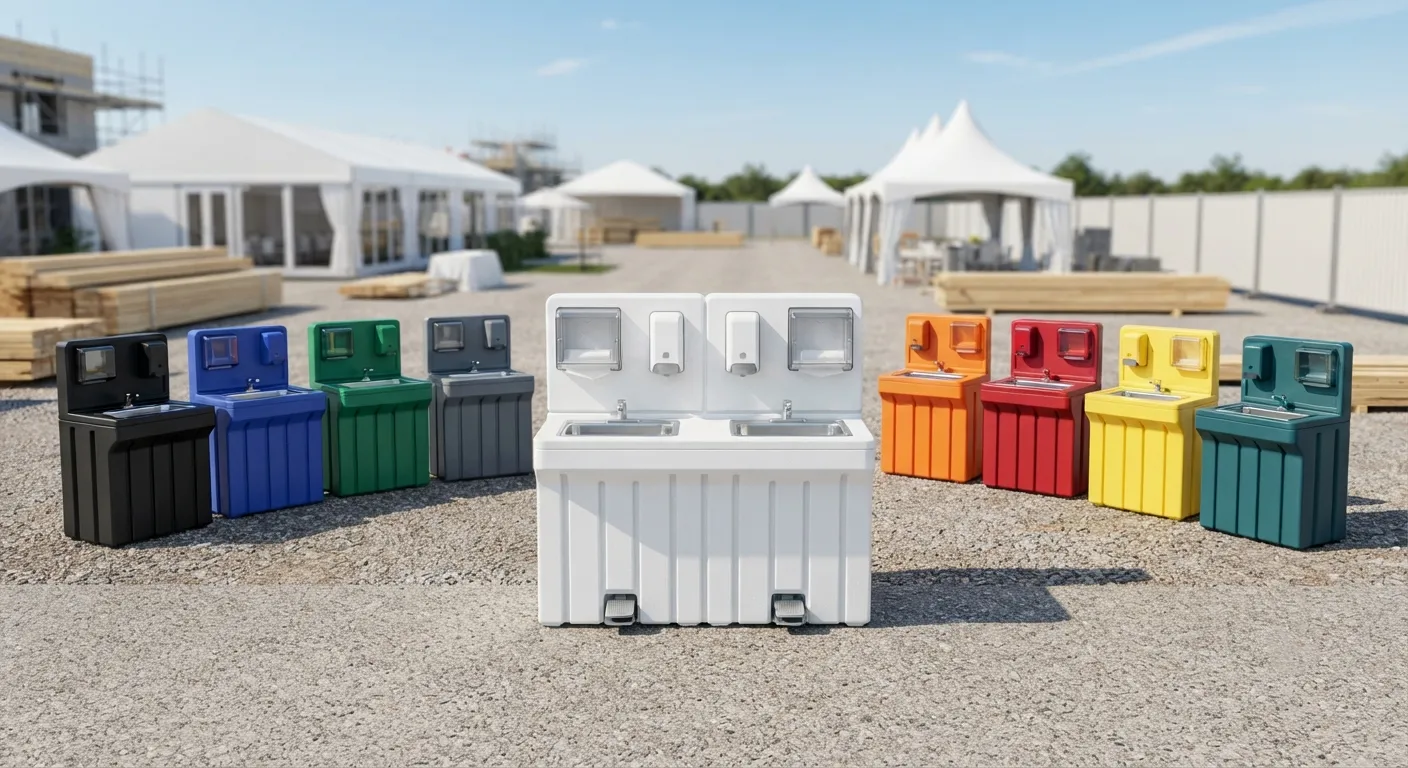
What handwashing setup fits a Jackson job site?
Most Jackson contractors pair one portable sink per 20 to 25 workers with their existing toilet order, which lines up with both the 1926.51(c)(1) toilet ratio and the field sanitation ratio in 1928.110 for ag crews. A basic freestanding sink unit works for short jobs. Events and film shoots often want something nicer at the entrance. If you are running an event restroom rental setup for a wedding or festival, a deluxe flushable porta potty cluster with a matching sink station looks a lot better at the gate than a bare unit. For larger crews or multi-week jobs, a bank of sinks next to a 4 stall restroom trailer or 8 stall restroom trailer keeps the whole wash line in one spot instead of scattered across the lot. ADA Standards section 308.2.1 sets a 48 inch maximum and 15 inch minimum forward reach for any fixture someone has to use from a seated position, so if your job needs an ADA accessible porta potty nearby, the sink height and reach need to match that same standard.
Where should handwashing stations go on site?
Place stations near the work, not near the office trailer. That is the whole point of the OSHA 1928.110 quarter-mile rule, and it is good practice even where that rule does not technically apply. On a typical Jackson build site, that means a sink at each toilet cluster rather than one central bank by the gate. Ground under the station should be stable and slip resistant, the same standard ADA Standards section 302.1 sets for accessible routes, which matters most after Jackson rain turns a gravel lot soft. Keep at least 36 inches of clear path to each unit per ADA Standards section 403.5.1 if the site serves the public, and route delivery trucks so they have the roughly 60 feet of straight clearance a roll-off or trailer delivery needs to back in. Our porta potty placement guide covers spacing in more detail, and the ADA restroom requirements page walks through clearance and reach specs site by site.
Pricing for sinks runs alongside your toilet order rather than as a separate delivery in most cases; see porta potty rental cost and porta potty rental per day for the toilet side of that math, or monthly porta potty rental if the job runs long. Jackson Porta Pros also delivers to Richland, 8.9 miles southeast, and Clinton, 9.7 miles west, on the same route as most Jackson drops.
Frequently asked questions
Do I need a handwashing station if I already have porta potties?
Depends on the work. If crews handle paints, coatings, or pesticides, OSHA 1926.51(f)(1) requires washing facilities regardless of toilet count. For general labor without those contaminants, toilets alone may satisfy 1926.51(c)(1), but most Jackson crews add a sink anyway.
Does hand sanitizer meet the OSHA requirement?
No. 29 CFR 1910.141(d)(2) requires soap plus towels or a hand drying device at wash stations. A sanitizer dispenser can supplement that but does not replace it on its own.
How many handwashing stations does an ag crew need?
OSHA 1928.110 sets one facility per 20 hand-labor workers, positioned within a quarter mile walk of the work area. Spread across a large field, that often means several smaller stations instead of one central setup.
Can I rent a sink alongside my portable toilets?
Yes. Most Jackson orders bundle a portable sink rental with existing toilet units on the same delivery, which keeps trip costs down and covers both the washing and toilet requirements together.
What is the ADA reach requirement for a sink station?
ADA Standards section 308.2.1 sets a 48 inch maximum and 15 inch minimum forward reach. Section 309.4 also requires operable parts, like faucet handles, to work with one hand and no tight grasping.
Next step
Get a delivery date
Tell us the address, the dates and the headcount. We size the order and confirm the route.